

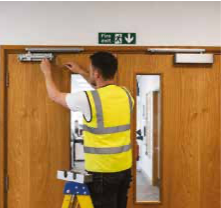
Fire door compliance now depends as much on the paper trail as the install. For installers, inspectors and the specialists who appoint them, the right digital tools are becoming the difference between proving compliance and hoping for the best.
Fire door compliance has never been under closer scrutiny. Under the Fire Safety (England) Regulations 2022, inspections are required quarterly for communal doors and annual for flat entrance doors. The Building Safety Act has pushed the golden thread of information from a nice-to-have into a legal expectation.
And the evidence suggests the industry is struggling with exactly that part. Early findings from Building Safety Regulator audits of safety case documentation for higher-risk buildings suggest that fire door record-keeping is one of the most common areas of non-compliance—not because the doors themselves are always wrong, but because the paper trail behind them isn’t there when someone asks for it. Fire risk assessors, principal accountable persons and insurers are all asking sharper questions than they were three years ago, and they want answers backed by evidence, not assurances.
For fire door specialists and the subcontractors who install, survey and maintain them, this shifts the job. Getting the door right has always mattered. Now, proving it’s right—who installed it, when, to what standard, with what materials—matters just as much. A missing record can undo acompliant install just as easily as a poor one.
Choosing contractors who can prove it
This is why, even if you’re not the one carrying out the fire door survey yourself, the contractors you choose to work with matter more than ever. A main contractor, building owner or managing agent appointing a fire door specialist isn’t just buying an installation— they’re buying a record they can stand behind when a fire risk assessor, auditor or insurer comes asking. Choosing contractors who use modern digital tools like Onetrace makes that difference tangible.
With Onetrace, that record isn’t assembled retrospectively from photos on someone’s phone and a stack of paper surveys. It’s built into the way the work happens:
- Instant access to records.Each fire door or installation can be tagged with a QR code, letting anyone on site scan and instantly see its inspection or maintenance history.
- Clear building overview. Complex buildings are kept under control with digital sites divided into floors and zones, so a 500-door residential block is as easy to navigate as a single-storey unit.
- Accurate, consistent data. Pre- built templates make it simple to record the right information every time, ensuring consistency across surveyors, sites and projects.
- Transparency and trust. Every action is logged, so contractors can easily prove compliance and demonstrate a clear audit trail to insurers, clients or regulators.
Opening the record up— without opening up the risk
Onetrace has recently introduced public QR codes, a feature built specifically for the moments when compliance evidence needs to leave the contractor’s own system. Public QR codes let a business share selected job sheets and location data with external auditors or contractors on site—without those people needing a Onetrace account—while keeping sensitive data secure.
In practice, that means:
- Controlled public access. Contractors choose exactly which job sheet and location details are visible via a public QR code, so sensitive commercial information stays protected while compliance evidence doesn’t.
- No account required. External auditors and contractors can view evidence of work instantly, without logins, passwords or onboarding.
- Point-of-need visibility. Scan the code on site and the relevant job record is there in read-only form—no phone calls back to the office, no waiting for someone to dig out a file.
For installers, this removes a genuine friction point. A fire risk assessor or a main contractor’s own auditor can verify a door’s history on the spot, rather than the installer chasing down records after the fact or granting broader system access than the moment requires.
What this looks like in practice
NRT Carpentry, a long-established carpentry contractor now running fire door surveys across multiple London sites, used Onetrace’s custom statuses to track thousands of doors through every stage of a survey—from pin drop to final approval and back again if remedial work was needed. As the business put it: “They are now a vital part of what we do, incorporated into every daily activity across all fire door projects.”
Golden Thread Fire Delay faced a harder problem on a 2,500- door installation, remediation and inspection project at Greenwich University: non-standardised worksheets meant information had to be double-checked, often requiring a second site visit. Standardising on Onetrace’s forms and templates removed that duplication, while guest access let clients view and inspect work remotely—contracts manager Kris Konieczka noted the business had saved “hundreds of hours of administrative work” on that project alone.
Frank Rogers Building Contractors, meanwhile, use Onetrace’s QR- tagging to keep compliance evidence attached to the door itself. As Jay Sefton, Head of Fire Door Compliance, put it: “The system allows us to QR-stamp our doors, keeping all compliance evidence in one place. I can be on holiday and still check projects in Cardiff, Scotland, or Liverpool in seconds. It’s all live, and it’s accurate.”
And at Qualifire, a Scotland-based passive fire protection specialist, guest access has changed how fire engineers sign off remedial work – reviewing and approving remotely rather than making repeat site visits. Director Audrey Stewart called the change “a huge time-saving.”
The outcome
None of this is about replacing the survey or the install—the door still has to be surveyed, fitted and checked by someone competent. What changes is what happens to that work afterwards: whether it’s captured once, correctly, and instantly retrievable by anyone with a legitimate reason to see it—or whether it lives in a phone, a folder, or someone’s memory.
For fire door specialists, that’s a stronger commercial position. For the businesses appointing them, it’s a simpler due diligence question: can this contractor show me the evidence, on the spot, without a chase?
Visit onetrace.com to see how fire door specialists are simplifying compliance.
Editor’s Note: Correction: An earlier version of this article misstated fire door inspection frequencies. Under the Fire Safety (England) Regulations 2022, inspections are required quarterly for communal doors and annually for flat entrance doors. The online text has been updated 03/08/2026.


